We wanted to test how fast our Metasystem can build the core technology behind LLM Routing.
The answer is 12 hours.
October 15, 2026
What is LLM Routing?
Enterprises spent an estimated $12.5 billion on foundation-model APIs in 2025 alone, prompting companies to search for ways to be smarter
about their AI usage. A number of companies have started to provide LLM routing products that
help enterprises save money by routing some of their LLM calls to cheaper models. Analysts
expect the LLM routing market to grow 20–45% a year through the next decade, reaching an
estimated $4–6.5 billion.
We wanted to test how fast our Metasystem can build the core technology behind this
industry. It took 1 engineer 2.5 weeks from data collection to full results. Only 12 hours of
that was the Metasystem optimizing the router.
Not every task requires the most expensive LLM; some questions are easy, and for those,
cheaper models suffice. How do we automatically decide which questions should be sent to
which models so that they are answered correctly, but with minimum expense?
The job of the LLM router is to figure out the best model for a query and then “route” it to
that model. If the router is doing its job, it will save money by routing simple queries to
cheaper models. Interestingly, if the router has learned correct, sufficiently granular rules, it can even do what might seem impossible: save money while
producing better results. Because of each LLM’s own jagged frontier of capabilities,
for some tasks a cheaper model outperforms an expensive one; the router just has to identify
those tasks.
LLM Routing is Not One-Size-Fits-All
Because each company’s LLM usage distribution is unique, each will have its own mix of
domains and types of questions, its own budget constraints, and models that they are
committed to use (for example, pre-existing contracts with OpenAI or Anthropic). We can
learn a bespoke router for any set of requirements. In every case, we use the Poetiq
Metasystem to optimize the routing decisions.
Three Scenarios
In this post, we simulate three distributions, each from a different industry, with its own
pattern of LLM usage:
Legal-R-US uses multiple frontier providers, making queries about legal, marketing, finance, HR and more.
Economics Inc has pre-commitments to use Anthropic models and wants to make the best use
of tokens with this provider. Its queries are split roughly evenly among economics, coding and math.
Privacy-4-U, LLC works in the same domain as Legal-R-US but is very concerned about privacy — it only uses open-weights models.
1. Legal-R-US: several model providers
Legal-R-Us is a large law firm. Its employees’ biggest use of LLMs is researching prior law and marketing its services. It also has some usage across
HR/Finance/Medical as usual, and even a small software team that builds in-house tools.
Legal-R-Us has agreements with four providers and wants the best-quality answers per dollar
across all of them: Claude Opus 5 (Anthropic), Grok 4.6 (xAI),
Muse Spark 1.1 (Meta) and Gemini 3.5 Flash-Lite (Google).
Topic
Share of questions
What the questions look like
Legal
22.6%
Case law and statutes, e.g. how a landmark ruling was decided, then applying a
damages test
Marketing
19.1%
Ad-platform history and campaign summaries
Finance
15.8%
Securities rules, compliance windows and disclosure periods
HR
15.0%
Employment-law thresholds and policy timelines
Software
15.0%
Code analysis
Medical
12.5%
Clinical and pharmacology facts
Legal-R-Us’s question mix. Questions are generated via Poetiq’s Augur to
create benchmarks and questions that no model could have memorized.
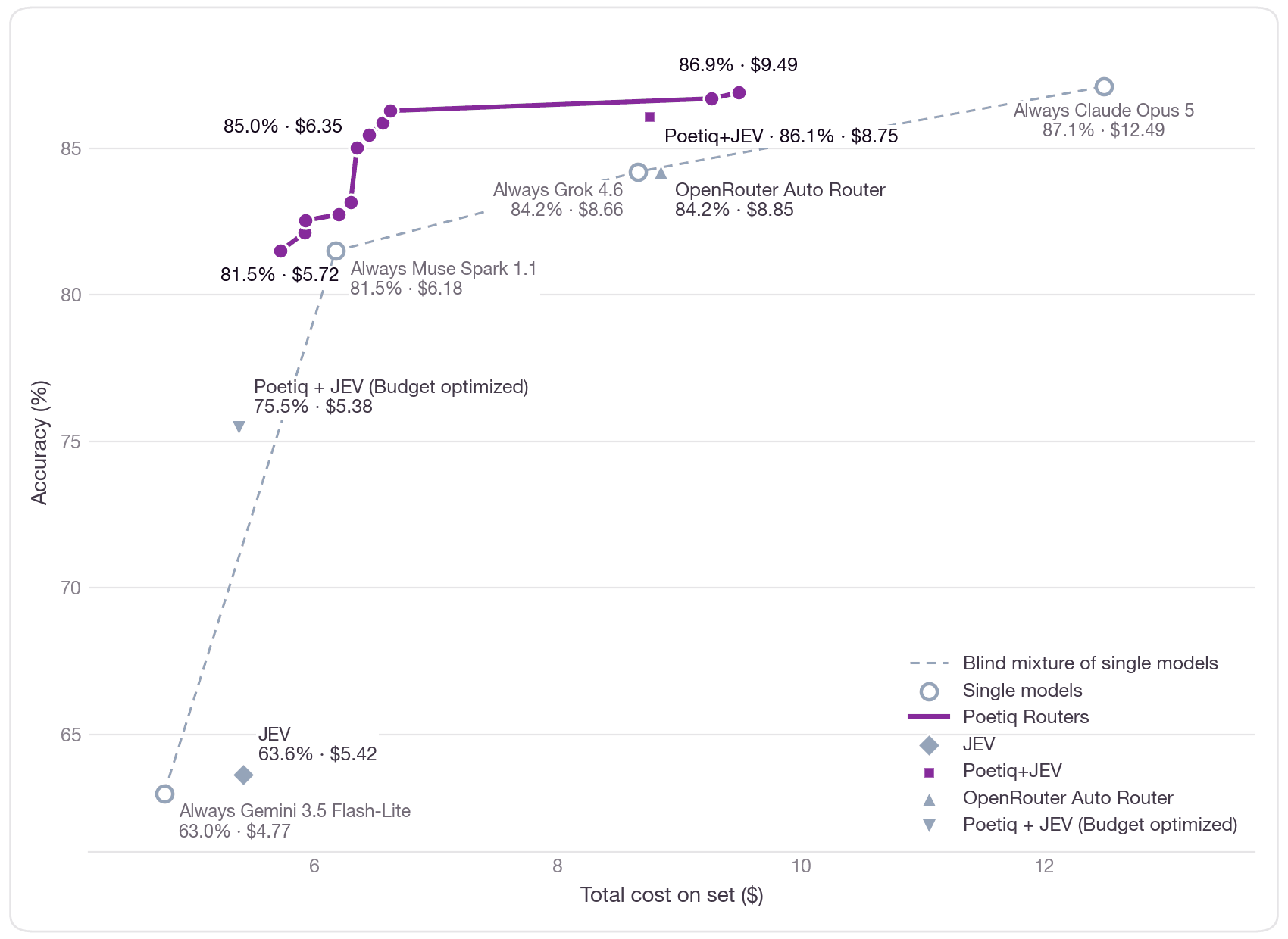
Our Metasystem can create a routing harness targeting any cost-accuracy
tradeoff point that a company may wish for. The results in Figure 1 show how the optimized
routers perform at any price point. The best router is 20% cheaper than Claude Opus 5 with
no statistical difference in accuracy.
For a large law firm this translates to savings of millions of dollars a year!
Figure 1: Each purple point is a router the Metasystem built for Legal-R-US. Open circles show what always using one model gets you. The most accurate router is ~20% cheaper than Claude Opus 5 while maintaining quality. OpenRouter’s Auto Router (grey) lands next to always-Grok. JEV picks almost exclusively the cheapest model and loses a lot of accuracy because of that.
Additionally, we compared our results to OpenRouter’s Auto Router and to JEV (a classification model). We beat OpenRouter on both price and accuracy. With respect to
JEV, note JEV’s poor performance – close to the bottom of all the tested models. From
inception, our Metasystem was designed to work with many kinds of AI architectures, not just
chatbot-style LLMs.
Without any modification, we used it to optimize harnesses for JEV.
When set to approximate JEV’s price, our harness easily surpasses JEV (63.6% @ $5.42) by a
wide margin at a lower price (75.5%, $5.38). When set to prioritize accuracy, the
JEV harness improvement was dramatic (86.1%, $8.75), although our fully optimized routers
(that were not forced to use JEV) still dominated it.
A look inside
Here, we visualize the decision process for the router. The animation shows a number of
questions as they are being routed through the decision tree. Notice that the Metasystem added a “fallback” option to make an LLM call when it was
uncertain. In practice, fewer than 1% of questions needed that extra LLM call, which makes the
router cost $0 for 99% of the decisions.
The Metasystem learned that Muse and Grok are better on specific subcategories of the data, and the optimized harness routes to those. For example, it decided to route case-law questions to Opus, but found that for statute or regulation questions it can get 3% higher accuracy and a 20% cost saving by sending them to Grok. Overall it routes about 50% to Opus 5,
just under 25% each for Muse and Grok, and a small amount to Gemini Flash Lite.
2. Economics Inc.: Anthropic credits
Economics Inc. pre-purchased a large block of Anthropic credits, is
allowed to spend on any Anthropic model, and wants the highest-quality answers while
stretching its token use as much as possible. It has selected Claude Opus 5 at
three reasoning-effort levels (high, medium and low) and Claude Sonnet 5.
Its work is largely technical and splits evenly across three areas.
Topic
Share of questions
What the questions look like
Economics
34.7%
Economic theory applied through a short chain of decisions and arithmetic
Coding
33.1%
Correctness and execution
Mathematics
32.3%
Algebra and number-theory facts that drive some calculation
Economics Inc’s question mix.
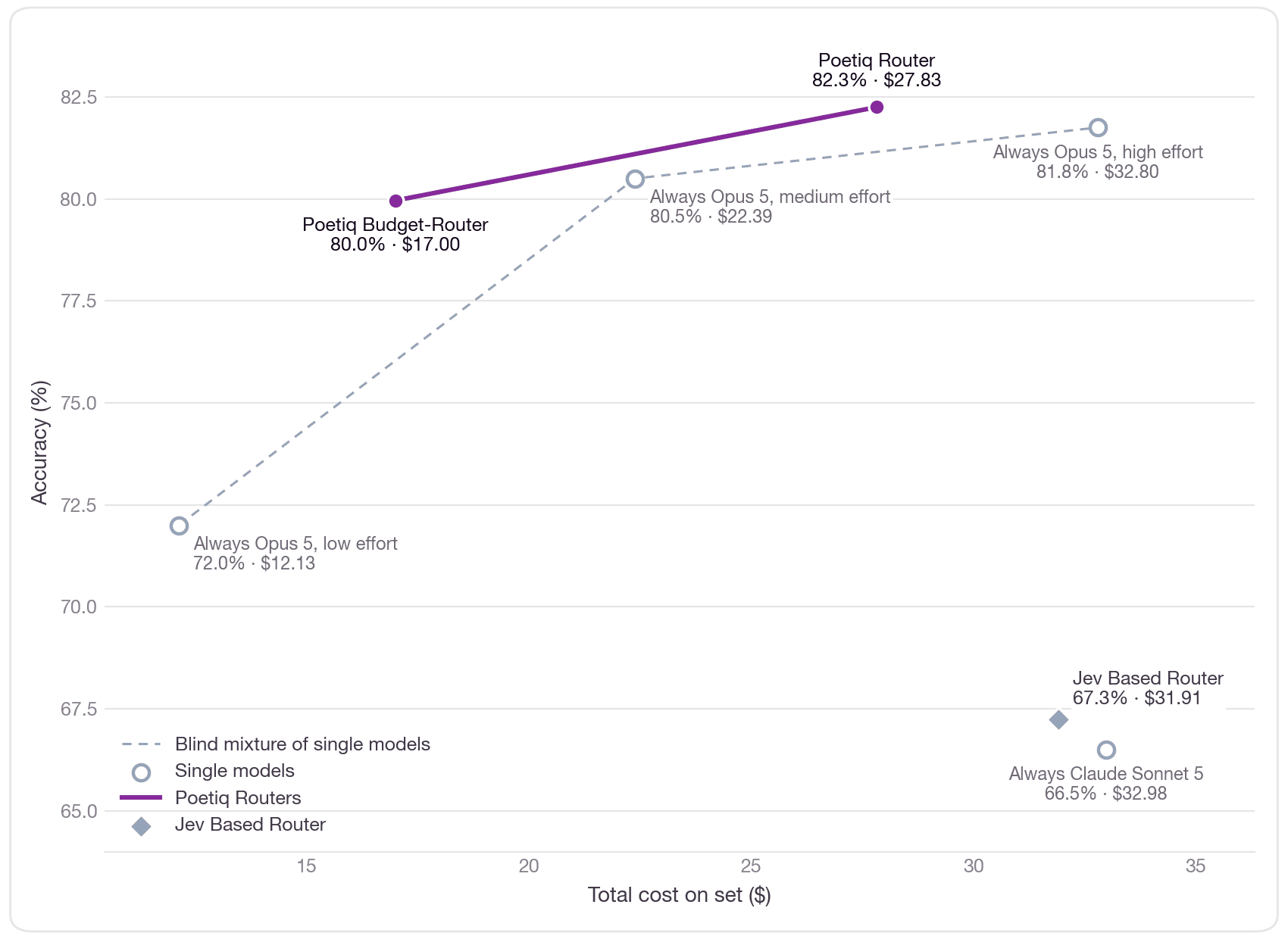
We ran our Metasystem to select between Opus 5 and Sonnet 5 and decide what level of
thinking effort is needed for the problem. The Poetiq Metasystem optimized a router that can
now serve 15% more tokens with the same number of credits, while maintaining (slightly
improving!) accuracy. The top router splits the questions between all options: high effort
for about 40% of questions, medium for 37%, low for 22%, and Sonnet for the remaining 1%. Its decision method is similar to the previous company’s, but the features and decision algorithm it
learned are fully specific to this distribution of data.
We also sent these queries to JEV. Again, JEV tends to focus on one model, sending ~90% of its
queries to Sonnet, which it thinks will be the cheapest based on per-token price. However, Sonnet tends to overthink on these prompts and turns out to be quite expensive on average.
Figure 2: Routing accuracies and costs on the Economics Inc question mix. The Poetiq router is more accurate and 15% cheaper than Opus 5 at high effort. With a modest accuracy drop, we save almost 40% in token costs.
3. Privacy-4-U, LLC: open weights only
Privacy-4-U, LLC is very careful with privacy. It doesn’t want Anthropic or OpenAI to have access to its clients' private data. It only uses open-weights models. It chooses between DeepSeek V4 Pro, DeepSeek V4 Flash,
Kimi K3, GLM 5.3 and GLM 5.3 Flash, a price
range of roughly 30x from cheapest to most expensive. It works in the same six business
functions as Legal-R-US, with a different mix: more finance and HR, less software.
Topic
Share of questions
What the questions look like
Legal
22.0%
Case law and statutes
Finance
18.7%
Securities rules, compliance windows and disclosure periods
HR
17.2%
Employment-law thresholds and policy timelines
Marketing
17.2%
Ad-platform history and campaign arithmetic
Medical
13.4%
Clinical and pharmacology facts
Software
11.6%
Working out exactly what a piece of code does
Privacy-4-U's question mix.
The choices in routing for Privacy-4-U have drastic ramifications for final cost. Kimi K3 is the most accurate single model at 85.79%, for $23.9. GLM Flash costs twenty times
less, but gets only 59.9%. The Poetiq Metasystem filled in the whole space between them. No single model offers anything between DeepSeek V4 Pro’s $12.3 and Kimi K3’s $24; the routers, however, can.
Router
Accuracy
Cost
Notes
Poetiq Router 1
86.8%
$22.6
Better and cheaper than Kimi K3
Always Kimi K3
85.8%
$24
Poetiq Router 2
85.7%
$15.5
Ties Kimi at 65% of its cost
Always DeepSeek V4 Pro
80.1%
$12.3
Always GLM 5.3
70.4%
$34.9
Poetiq Router 3
66.8%
$1.1
Same cost as GLM Flash and 10% relative increase in accuracy.
Always GLM 5.3 Flash
59.9%
$1.1
Why LLM Routing
LLM routing is a drop-in module that can save companies enormous amounts in expense, while
providing customized solutions that yield equal or better accuracy. When done well, beyond
large savings, it also has the benefit of eliminating the dependency on any single LLM
provider or model family, and the potential to ensure that data is private – not by policy,
but by design.
For Poetiq, this is a representative example to show how our harnesses and, more generally, our approach to optimization tackle real-world problems that have immense, immediate, industry-wide commercial implications.
We created this agentic harness without any modification to the Poetiq
Metasystem – it was just another task like the benchmarks we’ve done in the past – and it was solved quickly and entirely automatically.
Optimize With Us
Poetiq is a rapidly growing technical team with backgrounds from Google DeepMind, Apple,
Microsoft, Amazon, and ByteDance, all focused on the goal of creating AI systems that rapidly
improve themselves.
Are you ready to experience intelligence beyond Fable for a fraction of the cost? We'd like
to hear from you. And if you want to be a part of the team, please join us.